


The Difference Between a Cliffhanger and a Cliff Edge
Most writers know the sensation of finishing a chapter and feeling vaguely dissatisfied with the ending they've written. They add a dramatic final line—a gunshot in the distance, a door opening to reveal someone unexpected—and convince themselves the reader will keep going. Sometimes they do. More often, the chapter ending lands with a hollow thud that readers can't quite name but absolutely feel.
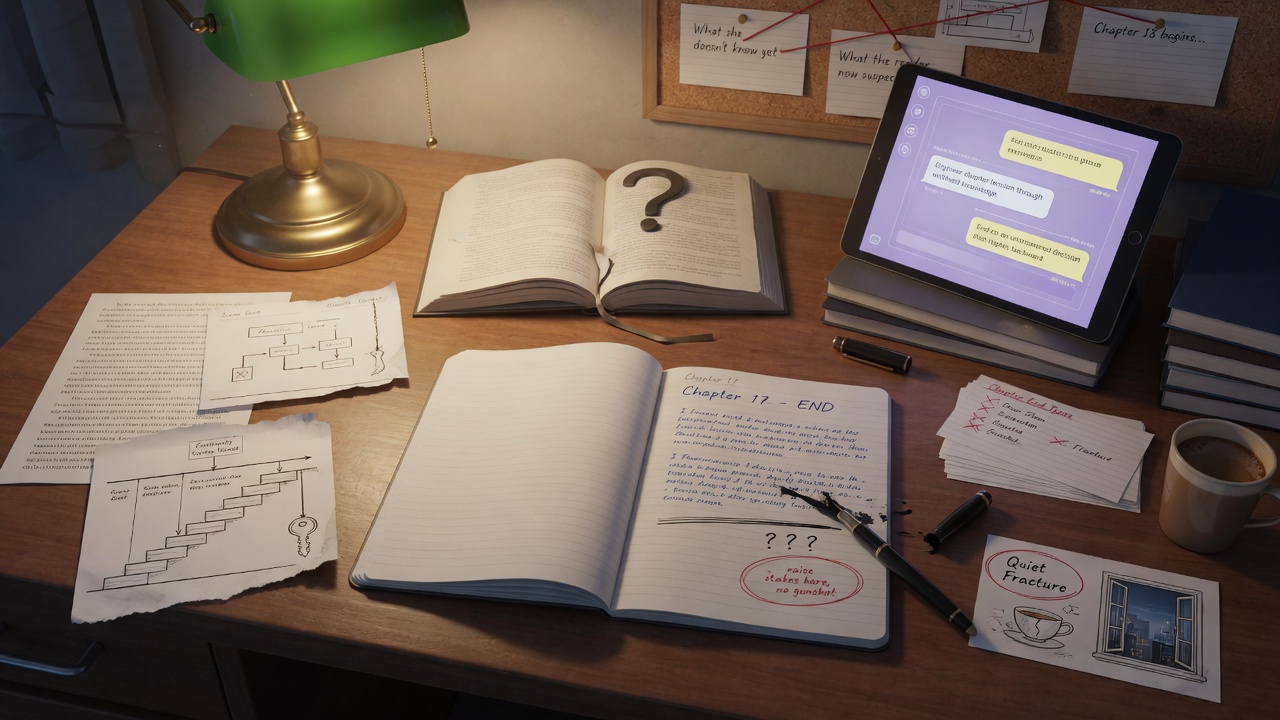
The distinction worth understanding is the difference between unresolved action and unresolved meaning. A cliff edge is pure spectacle: something happens, the scene cuts, and the reader is theoretically in suspense. A genuine cliffhanger, by contrast, suspends not just plot mechanics but a question with emotional weight—one that the chapter itself has been quietly constructing. The reader doesn't just want to know what happens next. They need to know, because the stakes have been made personal.
This is where AI becomes a genuinely useful collaborator, not as a generator of dramatic lines but as an auditor. Because AI can read your chapter text without the blind spots your own familiarity creates, it can identify whether your ending connects to anything that came before it, or whether it arrived by parachute at the final paragraph.
The prompts in this piece are designed for that auditing work, for drafting alternates, and for continuity tracking—the unglamorous structural labor that separates a chapter ending readers remember from one they quietly resent.
Mapping Cliffhanger Type to Chapter Function
Not all chapter-ending tension works the same way, and prompting AI effectively means being precise about which type of cliffhanger you're building. Each serves a different narrative function, and treating them as interchangeable is how writers end up with endings that technically qualify as suspenseful but feel tonally wrong for the chapter they're closing.
Revelation Cliffhangers
These end with information the reader receives—a letter, an overheard conversation, a discovered object. The tension comes from dramatic irony or from sudden recontextualization of what the reader thought they understood. These work best when the chapter has been subtly building toward a question, even if the reader wasn't consciously asking it.
Decision Cliffhangers
The character stands at a choice point, and the chapter closes before we see which way they go. The key structural requirement: the reader must understand why both options carry genuine cost. If only one option is plausible, there's no tension, only delay. These endings fail most often when the "wrong" choice isn't made frightening enough to be tempting.
Arrival Cliffhangers
Someone or something enters the scene. The chapter ends on the threshold. These are the most commonly abused type because they require the least setup—anyone can walk through a door. For them to earn their tension, the arriving element must be something the chapter has made matter, either through anticipation, dread, or specific emotional loading for this particular character.
Emotional-Bomb Cliffhangers
A line of dialogue, an internal realization, a piece of news—and the chapter ends not on external action but on the character's interior detonation. These are often the most powerful and the hardest to write because they depend entirely on whether the reader has been brought close enough to the character to feel the impact. AI is particularly useful here for checking whether you've established the emotional conditions necessary for the bomb to detonate with full force.
Prompting AI to Evaluate Whether Your Cliffhanger Is Load-Bearing
The most common structural failure in chapter endings isn't bad writing at the sentence level. It's that the ending isn't connected to the chapter's load-bearing architecture—the scene goal established in the opening pages, the character's specific want in this scene, the obstacle that's been generating friction throughout. When the cliffhanger is parachuted into the final paragraph without those connections, readers feel cheated even if they can't articulate why.
The following prompt is designed to give AI the structural context it needs to perform a genuine audit rather than a surface-level read:
I'm going to share a complete chapter draft with you and ask you to evaluate whether the chapter ending is structurally load-bearing or manufactured. Before you assess anything, I want you to identify the following from the text itself—do not let me tell you these things, find them in the chapter: 1. The scene goal: what does the POV character want or need from this scene at the chapter's opening? State it in one specific sentence. 2. The primary obstacle: what is blocking or complicating that goal? Be specific about whether it's external (another character, circumstance) or internal (belief, fear, limitation). 3. The chapter's emotional spine: what is the character feeling at the start, what triggers a shift, and what are they feeling at the end? Once you've identified those three things, read the final two paragraphs and answer these questions: - Does the cliffhanger ending connect directly to the scene goal you identified, or does it introduce a new element not prepared for earlier in the chapter? - Does it raise the emotional stakes on something the chapter has already established as mattering to this character? - If a reader skipped the body of the chapter and read only the last paragraph, would the ending feel arbitrary? Give me a frank structural verdict: earned tension, partially earned, or manufactured. Explain your reasoning with specific references to lines from the chapter. Do not soften your assessment. [Paste full chapter here]
The instruction to find rather than be told these structural elements is important. If you tell the AI your scene goal, it will evaluate the ending against what you believe you wrote, not against what you actually wrote. The gap between those two things is usually where the problem lives.
Drafting Alternate Last Paragraphs
Once you know whether your current ending is load-bearing, the next useful operation is comparative drafting. Reading five versions of the same ending against each other teaches you something a single draft can't: which tension register actually fits what the chapter has been doing.
The following prompt is built for this work, and it's intentionally demanding about variation. If you ask for "a few different versions," you'll get the same ending with minor word substitutions. The constraint specifications below force genuine range:
Using the chapter I've shared, draft five alternate final paragraphs for this chapter. Each version should attempt to create genuine forward tension—the compulsion to read the next chapter—but through a different mechanism and at a different emotional register. Here are the five approaches I want you to use: 1. REVELATION: End on information the reader receives that reframes something from earlier in the chapter. The POV character may or may not understand its significance yet. 2. INTERIORITY: End entirely inside the character's consciousness—no new external event. The final line should be a realization or admission that shifts what we understand about this character's inner life. 3. SENSORY DISPLACEMENT: End on a physical detail or sensation that carries emotional weight—something the character notices rather than thinks. The tension should be implicit, not stated. 4. DIALOGUE CUT: End on a line of dialogue, spoken or about to be spoken, that the chapter has been building toward—something that cannot be taken back. Cut immediately after the line; do not show the response. 5. STRUCTURAL INVERSION: End in a way that makes the chapter's apparent goal feel wrong—the character got what they wanted, or thinks they did, and a single detail suggests it's a disaster. After all five drafts, do not tell me which is best. Instead, write one paragraph for each that identifies: (a) what type of reader anxiety it creates, (b) what it requires to be paid off in subsequent chapters, and (c) any tonal inconsistencies with the chapter's existing voice. [Paste full chapter here]
The post-draft analysis section is doing as much work as the drafts themselves. Understanding what each ending requires of subsequent chapters is how you avoid writing yourself into a corner—or how you deliberately choose to write yourself into one you know how to escape.
Using AI to Strengthen Cliffhangers That Arise from Character Stakes
The best chapter endings feel inevitable in retrospect. Not predictable—inevitable. The reader finishes the chapter and thinks, of course it ended there, that's exactly where it had to land. That quality comes from the cliffhanger being rooted in character stakes rather than plot mechanics, and it's the hardest quality to engineer from outside the draft.
AI can help you identify whether you've established the necessary emotional preconditions. The questions to ask it are specific and character-level:
- Has the reader been shown, not told, why the approaching threat or revelation matters to this specific character—not to people in general, but to this person's particular wound or want?
- Does the character's behavior in the scene demonstrate the stakes in action, or are the stakes only asserted in exposition?
- Is there an established cost for failure or change that makes the cliffhanger feel dangerous rather than merely uncertain?
When the answer to any of those is no, the fix is almost never in the final paragraph. It's in the middle of the chapter, in the scenes that should have been doing the emotional groundwork. AI is useful for identifying exactly which passage needs to be expanded or sharpened to make the ending land.
Continuity Checks: Making Sure the Cliffhanger Gets Paid Off
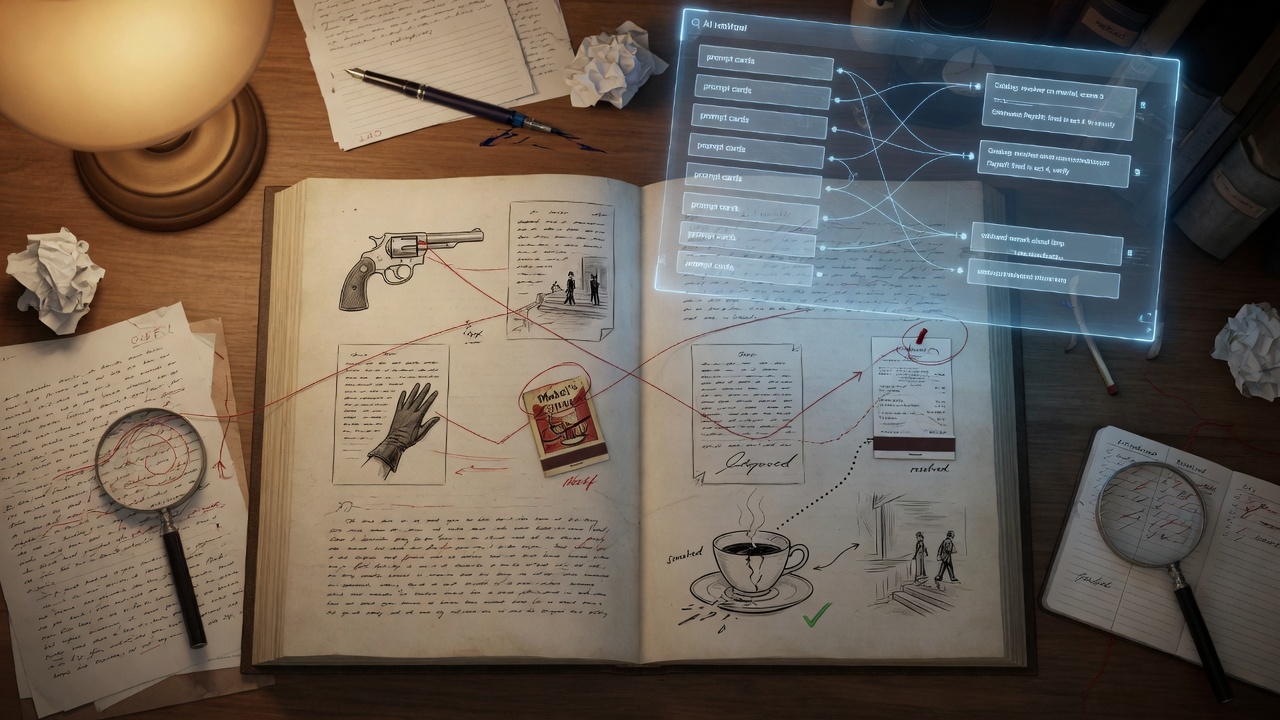
A cliffhanger that disappears is arguably worse than no cliffhanger at all. It trains readers not to trust you. They experience the forward tension, they turn the page, and the narrative simply moves on to something else—the character's terrifying revelation forgotten, the arriving figure never addressed, the decision somehow already made without the scene that should have dramatized it.
This happens more often than writers realize because chapters get drafted out of sequence, revisions shift narrative order, and the thread connecting the chapter ending to its resolution gets quietly severed. AI continuity checking won't catch everything, but it will catch the obvious failures if you prompt it correctly.
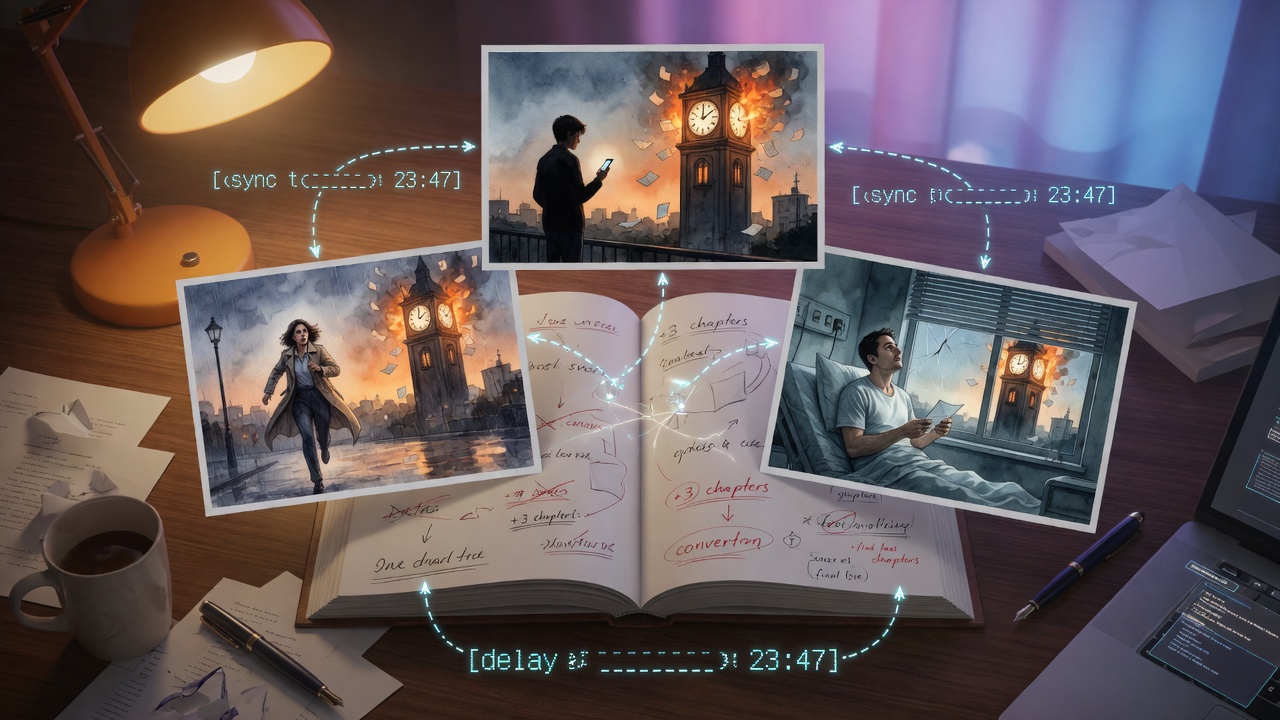
I'm going to share two consecutive chapter drafts from my novel. The first chapter ends on a cliffhanger. I need you to perform a continuity audit focused specifically on the handoff between these two chapters. After reading both chapters, answer the following: 1. IDENTIFICATION: State in one sentence exactly what the cliffhanger at the end of Chapter [X] establishes—the unresolved question, threat, revelation, or decision it leaves open. 2. RESOLUTION CHECK: Does Chapter [X+1] address this directly? If yes, in which paragraph does the resolution occur, and does it feel proportionate to the tension established? If no, flag this as a dropped thread. 3. DELAY ASSESSMENT: If the resolution is delayed beyond the opening scene of Chapter [X+1], identify whether the chapter provides a legitimate dramatic reason for the delay (the character is prevented from addressing it, time has passed, another crisis intervenes) or whether it appears to have been forgotten. 4. EMOTIONAL CONTINUITY: Does the emotional state of the POV character at the start of Chapter [X+1] reflect the state they were in at the end of Chapter [X]? If there's a tonal mismatch— the character was in crisis and opens the next chapter inexplicably calm—flag it with the specific lines that create the discontinuity. 5. READER TRUST SCORE: On a scale of one to five, rate how likely a reader is to feel the cliffhanger was honored. Explain your rating in two to three sentences. [Paste Chapter X and Chapter X+1 here]The "reader trust score" instruction might seem subjective, but its value is in forcing the AI to synthesize its specific findings into an overall judgment. A chapter that technically addresses the cliffhanger but does so in an emotionally perfunctory way—one line of acknowledgment before moving on—is still a broken promise, and this framing helps surface that failure.
The Architecture Beneath the Ending
What makes cliffhanger work genuinely difficult is that good chapter endings can't be retrofitted. They have to be grown from the chapter's own skeleton—the scene goal, the character's specific vulnerabilities, the emotional beat the narrative has been moving toward. You can draft a technically impressive final paragraph that generates real anxiety, but if the chapter beneath it hasn't been doing its work, readers will sense the fakery even if they can't diagnose it.
AI is most useful in this process not as a generator of dramatic lines but as a structural mirror—reflecting back what you've actually built versus what you believe you've built. The prompts above are designed to exploit that function: to audit before you draft, to generate comparative options before you commit, and to verify continuity before you move on.
The goal throughout is endings that feel earned—where the reader reaches the final line and experiences not just curiosity about what comes next, but the particular urgency that comes from caring about a specific person in a specific impossible position. That urgency is what turns pages. The AI's job is helping you build the conditions for it, chapter by chapter, ending by ending.
No comments yet. Be the first to comment!