

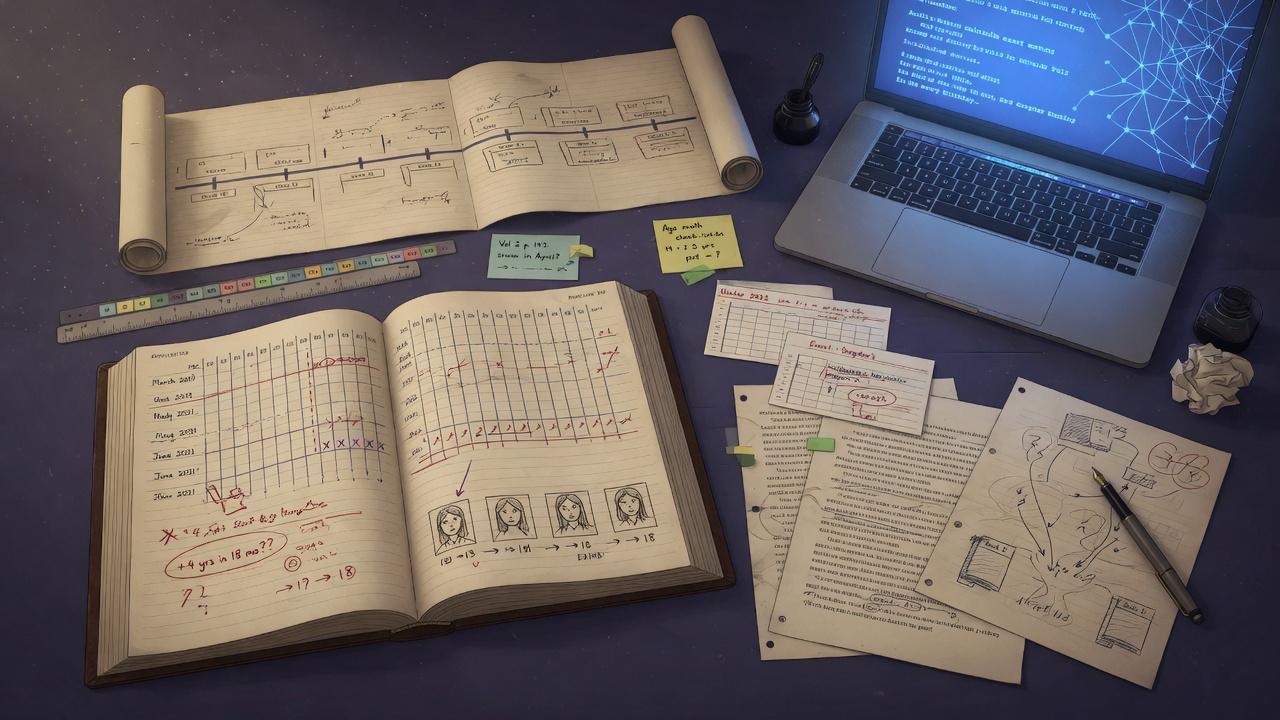
Somewhere around book three of a series, a reader emails to say your protagonist's daughter was seven in book one, nine in book two, and now she's supposedly fourteen despite only eighteen months passing in-story. You go back and check. The reader is right. You have no memory of aging her four years in a year and a half of plot time, but the text says what it says, and now it's in a published book that can't be quietly fixed.
This is the error that slips past everyone—you, your editor, your beta readers—because catching it requires holding a calendar in your head while you're busy holding a plot. Timeline drift is different from other continuity errors. If a character's eye color changes, that's a single fact contradicting another single fact, and a sharp reader or a simple search can find it. Timeline errors are cumulative. They're built from dozens of small, individually reasonable statements—"three weeks later," "the following spring," "she'd just turned twelve"—that only become a problem when you add them all up and discover they don't sum to anything coherent.
You know your plot intimately. You know what happens, in what order, and why. What you don't reliably hold in your head is the arithmetic underneath it—the actual elapsed days, the actual ages, the actual season-by-season math that your plot is quietly resting on. This is exactly the kind of bookkeeping task AI is suited for: not judging whether your story is good, but tracking hundreds of small numerical claims across hundreds of thousands of words and telling you where they stop adding up.
Below is a four-prompt system for building a timeline audit of your manuscript or series. Each one produces a different layer of the ledger—raw dates, character ages, biological and travel constraints, and recurring calendar events—so you can catch drift before a reader does the math for you.
Why You Can't Catch This Yourself (And Why That's Not a Craft Failure)
Writers often treat timeline errors as evidence of sloppiness, but they're really a structural side effect of how novels get written. You draft scenes in bursts, often out of order, often months or years apart in real time. Each scene feels internally consistent when you write it because you're anchored to what came immediately before—"it's been about a week since the wedding," you think, and that's true relative to the wedding. What you're not tracking is whether that week is the fourth "about a week" in a row that should have added up to a month, or whether the wedding itself was supposed to happen in autumn and you've since had two scenes of blooming flowers.
The problem compounds across a series because you're not just tracking one manuscript's internal clock—you're tracking a clock that spans multiple books, possibly written years apart, possibly with notes you no longer remember taking or never took at all. Nobody holds that much sequential arithmetic in working memory while also managing character voice, plot logic, and prose quality. This isn't a discipline problem. It's a volume problem, and volume problems are what AI tools handle well when you give them the right extraction task.
The Ledger Approach
The system below works in a specific order: first extract raw data, then check it against itself in progressively more specific ways. Don't skip to the age-check prompt without building the ledger first—the ledger is what lets you verify the AI's later claims instead of just trusting them.
Prompt 1: Build the Chronological Ledger
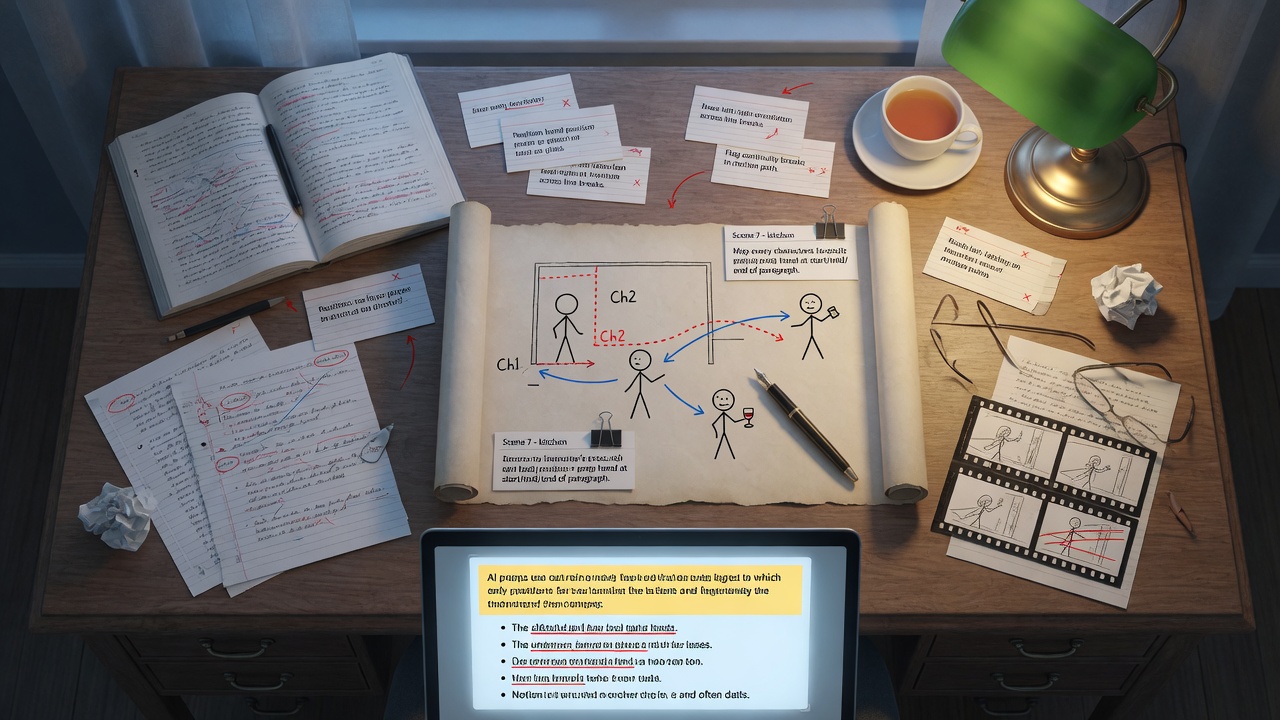
This is the foundation. You're asking the AI to pull out every explicit and implicit time reference in the manuscript and organize it into a single sequential document you can scan, sort, and argue with.
I'm going to paste in [a chapter / my full manuscript] from my novel. Extract every reference to time, dates, seasons, or elapsed duration into a chronological ledger. For each entry, give me: 1. The quote or paraphrase containing the time reference 2. The chapter/scene it appears in 3. The type of reference (explicit date, season, elapsed time since a prior event, age statement, holiday, weather/astronomical cue) 4. Your best estimate of where this places the scene on an absolute timeline, starting from an arbitrary Day 1 at the novel's opening Include even vague or implicit cues—"the leaves had started to turn," "it had been months since," "just before her birthday." Flag any reference where the elapsed time since the previous ledger entry seems ambiguous or could be read more than one way. Do not try to resolve contradictions yet. Just extract and organize. Present the output as a table sorted in the order these references appear in the text, not in narrative-chronological order, so I can see exactly where each claim shows up. Manuscript text: [paste text]
Run this chapter by chapter for a full manuscript rather than pasting the whole thing at once—context limits aside, you want granular, checkable output rather than one AI-synthesized summary you can't verify against the source. Once you have ledgers for every chapter, stitch them into one master document yourself. This is tedious. It's also the only way to have a ledger you actually trust, because you've seen every entry get pulled from the specific line that generated it.
Prompt 2: Cross-Check Character Ages
Age errors are the most reader-visible timeline mistake because readers do this math casually and remember round numbers. If your character was "ten years old" at the start of book one and the series spans a stated four years, readers will expect fourteen by book four's end, and they will notice if you've written sixteen.
Using the chronological ledger below, and the following list of character birth years or stated ages at fixed points in the story, check for age consistency across the entire series. Birth years / fixed age points: [list each major character with either a birth year relative to your story's epoch, or an explicit stated age at a specific dated point—e.g., "Mira: stated as 10 years old on the date of the harvest festival in Book 1, Chapter 3"] Ledger: [paste your master ledger] For each character, calculate their implied age at every point in the ledger where a scene is dated or can be dated relative to their fixed point. Flag any place where: - A stated age contradicts the age implied by elapsed time since their birth year or last fixed point - A character's described physical development, schooling stage, or life-milestone eligibility (e.g., marriage, military service, inheritance) seems inconsistent with their calculated age - Two characters' relative ages (e.g., "older brother," "twins," "born the same winter") don't hold up given their individual birth years Present findings as: Character | Scene/Chapter | Stated or Implied Age | Calculated Age | Discrepancy. Then rank the discrepancies by how visible they'd likely be to an attentive reader, from "reader will definitely notice" to "only visible if someone builds a spreadsheet."
That last ranking instruction matters more than it looks. Not every discrepancy is worth fixing before publication—some are true errors that only exist if a reader cross-references two books with a calculator, and your revision time is better spent on the ones that live inside a single scene or a single book, where the contradiction is close enough together that ordinary attentive reading catches it.
Prompt 3: Audit Biological and Geographic Time Constraints
This is the layer that catches the errors nobody thinks to look for: the wound that heals in four days when your world has established six weeks as realistic, the pregnancy that runs shorter than human gestation because two subplots' calendars didn't sync, the three-day horse ride that somehow happens between breakfast and dinner. These errors are easy to write because each individual scene reads fine in isolation—it's only against your own established world-rules that the math breaks.
I want you to audit my manuscript for violations of stated or implied physical constraints on time—travel duration, healing and recovery time, pregnancy and child development, seasonal cycles for agriculture or migration, and any other biological or physics-based process where duration is meaningful. First, here is a reference list of my world's established constraints. Where I haven't stated a rule explicitly, infer a reasonable real-world default and flag it as inferred rather than confirmed: [list what you've established: e.g., "Travel from Kesh to the capital takes 9 days by horse, 3 by river," "Serious sword wounds in this world take 3-6 weeks to heal enough for combat," "Pregnancy follows standard human gestation," "Winter lasts roughly 4 months in the northern provinces"] Now cross-reference the chronological ledger against the manuscript text and flag every instance where: - A journey happens faster than the stated/inferred travel time allows, given the ledger's dating of departure and arrival scenes - A character returns to physical capability (fighting, riding, hard labor) sooner than the healing timeline should allow given the severity of their injury as described - A pregnancy's timeline, once dated against conception and birth scenes, doesn't match gestation - A seasonal activity (harvest, migration, a described "dead of winter" scene) occurs at a point in the ledger that doesn't match the stated season for that part of the timeline For each flag, quote the relevant passages, state the constraint being violated, and calculate the actual elapsed time implied by the text versus the time the process should require. Ledger: [paste ledger] Manuscript excerpt(s): [paste relevant sections]
The instruction to infer defaults and mark them as inferred is doing real work here. Most writers never explicitly stated their world's healing rate or travel speed—it's implicit in how the story feels—and without that instruction, the AI will either invent a strict rule and hold you to it unfairly, or silently skip anything you haven't nailed down. Marking inferences separately from confirmed rules lets you decide, flag by flag, whether the AI guessed wrong about your world or whether your manuscript actually has a problem.
Prompt 4: Flag Recurring Holidays and Astronomical Events
Series that span multiple years accumulate a particular kind of error: the harvest festival that happens twice in one calendar year, the solstice that's referenced as both midsummer and midwinter in different books, the character's death-anniversary that gets observed on a date that shifts between installments. These are subtle because each individual mention is usually fine on its own—the error only exists in the gap between two books, often written years apart, where you've forgotten the specific date you used the first time.
Search the ledger and manuscript excerpts below for every mention of a recurring calendar event: named holidays, festivals, anniversaries (births, deaths, weddings, battles), and astronomical events (eclipses, solstices, equinoxes, specific named comets or celestial alignments if your world has them). For each recurring event, build a table showing every instance it's mentioned across the series, the book/chapter it appears in, and the calendar position implied (season, and if possible, the ledger's absolute day count). Then check for: - The same annual event landing in inconsistent seasons across different mentions - An event described as happening "every N years" (e.g., an eclipse, a census, a tournament) where the ledger's dating shows it recurring at the wrong interval, or occurring twice within a span shorter than N years - An anniversary (a death date, a founding date, a wedding anniversary) that's referenced at two different points in the series with two different implied calendar dates - Any holiday or event whose stated cultural meaning (e.g., "the festival marking the end of harvest") doesn't match the season the ledger implies for that mention List every discrepancy with direct quotes from both instances being compared, and note which mention is likely the "original" (earliest written or earliest in-story) so I know which version to treat as canon when I fix the other. Ledger and event mentions: [paste]
The "which is likely canon" instruction is a small but useful piece of judgment to ask for—when you find a contradiction between book one and book three, you generally want to preserve whichever version came first, since that's the one already in front of readers, and adjust the later instance rather than issuing a correction to something already published.
Building This Into Your Actual Process
None of these prompts are a one-time fix you run at the end. The ledger is most useful as a living document you update as you draft, so that by the time you reach book three of a planned trilogy, you're checking new chapters against an existing timeline rather than reconstructing three books' worth of dates retroactively. If you're already mid-series, though, retroactive reconstruction is exactly what these four prompts are for—tedious, unglamorous, and considerably cheaper than an errata page or a wave of reader emails asking how your protagonist aged four years in eighteen months.

No comments yet. Be the first to comment!