




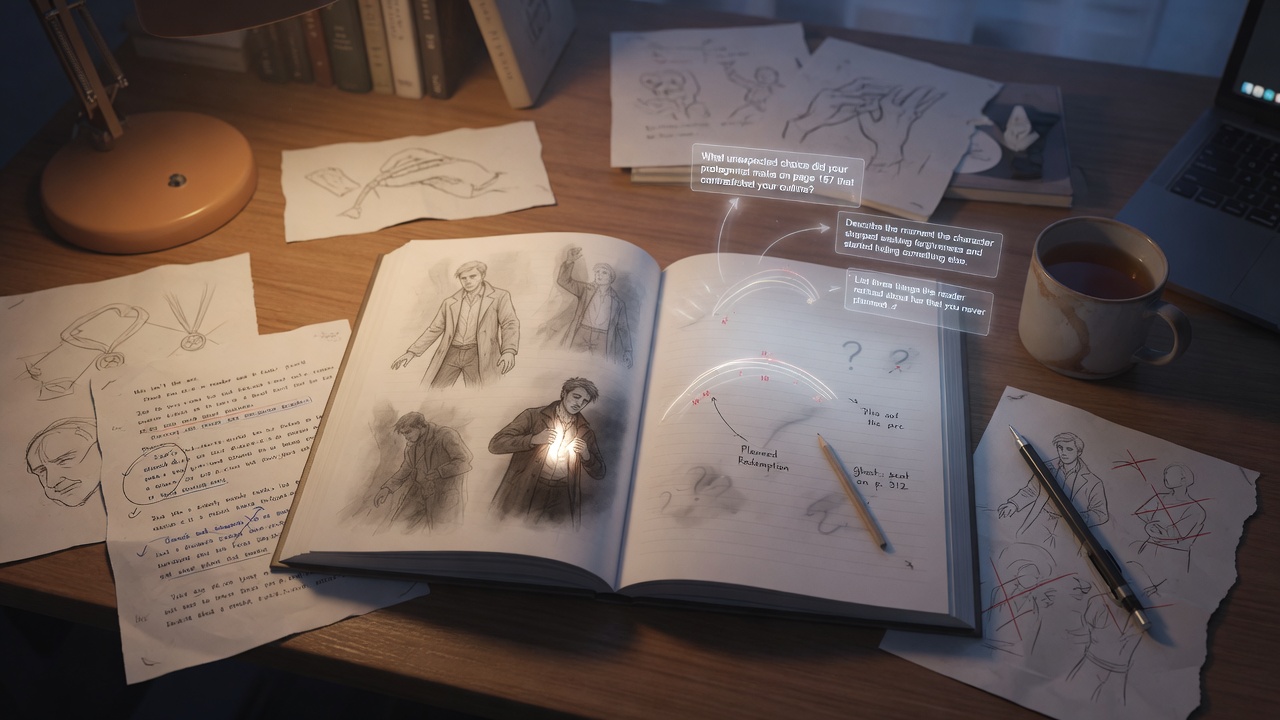
The Gap Between the Arc You Planned and the Arc You Wrote
You outlined a redemption story. A man who destroyed his family through ambition slowly learns to value presence over achievement. You knew where he started, knew the wound, knew the moment of reckoning in act three. You did the work. The outline was clean.
Then you wrote sixty thousand words, handed the draft to a trusted reader, and they said something that stopped you cold: "I don't think this is about ambition at all. This guy is terrified of being ordinary. That's a completely different thing."
They were right. And you had no idea you'd written it.
This happens constantly in long-form fiction, and it isn't a failure of craft. It's often a sign that your instincts are working at a level your conscious planning can't fully access. First drafts are where writers tell the truth before they've had a chance to curate it. The character you imagined and the character who emerged on the page are frequently not the same person — and the one on the page is often more interesting.
The problem is detection. Most writers don't notice the divergence until someone outside the manuscript names it, often late in revision when the cost of structural change is highest. Learning to find your own ghost arcs — the transformations quietly embedded in your prose — is one of the most useful diagnostic skills a novelist can develop. AI, fed the right prompts, turns out to be a remarkably good instrument for this kind of close behavioral reading.
What a Ghost Arc Actually Is
A ghost arc is a latent character transformation that accumulates across scenes through behavioral patterns, micro-decisions, and word-level choices — one that diverges from, contradicts, or quietly replaces the arc you consciously planned. It isn't a subplot. It isn't theme drift. It's a coherent emotional trajectory that your character is actually traveling, made visible only when you step back and read for evidence rather than intention.
Consider a few common manifestations across novel types:
- Literary fiction: A writer plans an arc about a grieving mother learning to reconnect with her surviving child. What the prose actually tracks, scene by scene, is the mother's growing refusal to accept a version of herself that needs anyone. The planned arc is about reopening. The ghost arc is about enclosure. Both involve grief. Only one is in the manuscript.
- Thriller: The intended arc is a burned intelligence operative rediscovering her sense of duty. But chapter after chapter, her decisions prioritize personal loyalty over mission objectives — she's not recovering duty, she's replacing it with something smaller and more human. The ghost arc is about learning the limits of idealism, not its restoration.
- Romance: The outline promises a commitment-phobic man opening his heart. The prose shows a woman who starts the novel deferring to everyone around her making, for the first time, a series of purely self-interested choices. She's the one transforming. He's the catalyst, not the arc.
Ghost arcs are almost always emotionally honest. They emerge from your intuitions about human behavior operating below the outline level. The question is whether to develop them deliberately or let them stay latent — and you can't make that decision until you've found them.
Prompting AI to Read for Behavioral Evidence
The first step is building what you might call a behavioral fingerprint: a catalog of what your character actually does, avoids, says, and refuses across the chapters you've written, stripped of your interpretive framing. You're not asking the AI to summarize the plot or name the theme. You're asking it to inventory evidence.
Feed the AI one to three chapters at a time and use a prompt structured like this:
I'm going to paste several chapters of my novel-in-progress. I need you to read them as a behavioral analyst, not a literary critic. Your task is to catalog every significant action, avoidance, micro-decision, and moment of hesitation made by [CHARACTER NAME] — not what happens to them, but what they choose, refuse, initiate, or deflect. For each item, note: - What the character did or avoided - What they could plausibly have done instead (the road not taken) - What emotion or value the choice appears to protect or advance - Any pattern you notice repeating across scenes Do not tell me what the arc is. Do not summarize. Give me only the behavioral inventory. I will interpret the patterns myself afterward. Here are the chapters: [PASTE TEXT]This prompt does something specific: it forces the AI away from narrative summary (what writers already know) and toward the granular level where ghost arcs actually live. The road-not-taken column is particularly valuable — it shows you what your character consistently refuses, which is often more revealing than what they pursue.
After running two or three batches of chapters through this process, you'll have a raw behavioral record. At that point, a follow-up prompt helps you look for the shape in the data:
Here is a behavioral inventory I've assembled for my protagonist across [X] chapters: [PASTE INVENTORY] Looking at this inventory as a whole, I want you to identify any coherent emotional logic that seems to be organizing these choices — not a theme or a lesson, but a specific psychological trajectory. What is this person moving toward or away from, based purely on what they do? If you see more than one possible trajectory, describe each one separately. Assign each a working label (two to five words) that captures the direction of movement. Do not tell me which one is the "real" arc. Give me the possibilities and the evidence for each.The reason to ask for multiple possibilities rather than a single answer is important: AI will default to the most narratively familiar arc if you give it permission to choose. Asking for competing interpretations keeps your options genuinely open.
The Comparison Audit: Putting Your Intended Arc Beside Your Ghost Arc
Once you have behavioral trajectories identified, the next step is the comparison audit — a structured prompt sequence that puts your planned arc and the emerging arc directly against each other and asks for scene-level scoring.
This requires you to articulate your intended arc clearly, which is harder than it sounds. Many writers have a gestural sense of what their character arc is without having formalized it in language precise enough to audit. The prompt below forces that precision:
I'm going to describe the character arc I planned for my protagonist, and then I'm going to paste a behavioral inventory drawn from my completed chapters. I need you to perform a comparison audit. My intended arc: [CHARACTER NAME] begins the novel as [STARTING CONDITION — specific psychological or behavioral state, not just a trait]. Over the course of the story, they move toward [ENDPOINT CONDITION]. The transformation is driven by [CORE WOUND OR MISBELIEF] being challenged by [TYPE OF PRESSURE OR EVENT]. By the end, they should demonstrate [CONCRETE BEHAVIORAL EVIDENCE OF CHANGE]. Here is the behavioral inventory from my actual chapters: [PASTE INVENTORY] For each item in the inventory, evaluate whether it constitutes: (A) Clear evidence supporting my intended arc (B) Neutral — compatible with the intended arc but not specifically confirming it (C) Evidence pulling against the intended arc, toward a different psychological trajectory At the end, give me a breakdown: what percentage of the behavioral evidence falls into each category? And for all Category C items, describe what alternative arc they seem to be building toward. Do not recommend which arc I should pursue. I want the audit only.The output from this prompt is often clarifying in ways that feel uncomfortable in the best sense. When a significant portion of behavioral evidence falls into Category C, you're not looking at scattered mistakes — you're looking at a ghost arc. The AI has just helped you see the shape of it.
Reading the Audit Results Without Panic
A common initial response to seeing that forty percent of your behavioral evidence contradicts your intended arc is to treat it as a problem to fix immediately. Resist that impulse. The audit is information, not a verdict. What you're looking for at this stage is coherence: are the Category C items random, or do they cluster around a specific alternative trajectory? Random divergence is noise. Coherent divergence is a ghost arc, and ghost arcs deserve consideration before they're corrected away.
Decision Point: Ghost Arc as Gift or Mistake
This is where the intellectual work of ghost arc detection becomes craft judgment. You have two arcs now — the one you planned and the one that emerged. You need to decide what to do with each. The prompts in this section are designed to help you evaluate the ghost arc on its merits before you make any changes to the manuscript.
Testing Whether the Ghost Arc Is Stronger
Strength in this context means emotional specificity, thematic resonance with your actual material, and the degree to which it honors what your characters seem to authentically need from the story. Ask the AI to help you think this through:
I've identified two competing arcs for my protagonist in a novel I'm writing. I need help evaluating them against each other — not to be told which is better, but to understand the implications of each. Arc A (Intended): [Describe the arc you planned — starting condition, transformation mechanism, endpoint, and what kind of story it produces] Arc B (Ghost Arc): [Describe the emergent arc as identified in the behavioral inventory — starting condition, trajectory, apparent endpoint, and what kind of story it would produce if developed deliberately] Please analyze each arc across four dimensions: 1. Specificity — which arc makes more precise claims about human psychology, as opposed to more general ones? 2. Tension with the plot — which arc creates more inherent conflict with the events I've described happening in the story? 3. Thematic coherence — based on the behavioral inventory and any details I've shared about the novel's other elements, which arc seems more native to the material? 4. Revision cost — what would it take to develop each arc fully from this point forward, and what scenes or decisions would need to change? Give me a clear-eyed breakdown for each dimension without declaring a winner.The revision cost dimension matters more than writers often admit. Sometimes the ghost arc is genuinely stronger, but developing it requires restructuring the first half of the manuscript in ways that aren't feasible given deadline or energy. That's a legitimate factor in the decision, and building it into the analysis keeps the conversation grounded.
If You Choose the Ghost Arc
Choosing to develop the emergent arc deliberately means two things: retrofitting earlier scenes to plant evidence that now looks intentional, and carrying the arc forward with full commitment. The behavioral inventory you've built becomes your guide for the retrofit — you now know which Category C scenes to amplify and which Category A scenes to interrogate for unintended mixed signals.
If You Choose to Reclaim the Intended Arc
Choosing the planned arc doesn't mean ignoring the ghost arc evidence — it means understanding why your instincts kept pulling away from the plan and addressing whatever is causing the drift. Often the ghost arc reveals that the intended arc is underspecified at the scene level: the writer knows the destination but hasn't worked out the moment-to-moment behavioral logic that would make a character actually move that direction. Use the Category C scenes as diagnostic tools. Each one tells you something about where the intended arc lacks sufficient resistance, temptation, or consequence to compel the behavior it needs.
Making the Process Repeatable
Ghost arc detection isn't a one-time intervention at the end of a draft. It's most useful as a recurring practice at the close of each act or major section, before the divergence compounds to the point where resolution becomes structurally expensive. Running a behavioral inventory every thirty thousand words or so keeps the feedback loop short enough that course corrections remain manageable.
The writers who use this process most effectively report a specific cognitive shift: they stop reading their own prose for confirmation of the plan and start reading it as evidence of something that is trying to emerge. That shift — from author as executor of the outline to author as listener to the manuscript — is where the most honest and surprising transformations tend to get found.
Your first draft is not a failed version of your outline. It's a document written by a part of your creative intelligence that had access to things your planning brain didn't. AI prompts structured around behavioral evidence give you a systematic way to read what that part of you wrote — and decide what to do with it.


No comments yet. Be the first to comment!