

The Confidence Problem at the Heart of Historical Fiction
Historical fiction lives and dies on sensory truth. Readers who care enough to pick up a novel set in 1780s Edinburgh or 1920s Cairo have almost certainly read widely in the period. They notice when a character unconsciously reaches for a fork that wouldn't exist yet, uses a phrase coined two decades later, or sits in a room lit by a lamp that burns the wrong kind of fuel. The anachronism doesn't have to be enormous to break the dream. A single wrong detail lands like a wrong note in a familiar piece of music.
This is exactly why the current generation of large language models presents a specific kind of danger for historical novelists—not because they know nothing about the past, but because they know a great deal, imperfectly, and deliver all of it at the same temperature of confidence. Ask an AI to describe the smell of a coaching inn in 1740 and it will respond with fluency and apparent authority. Some of what it tells you will be grounded in solid historical record. Some will be a plausible extrapolation. Some will be a confabulation. The model itself often cannot tell which is which, and it rarely volunteers that uncertainty unless you specifically engineer the prompt to demand it.
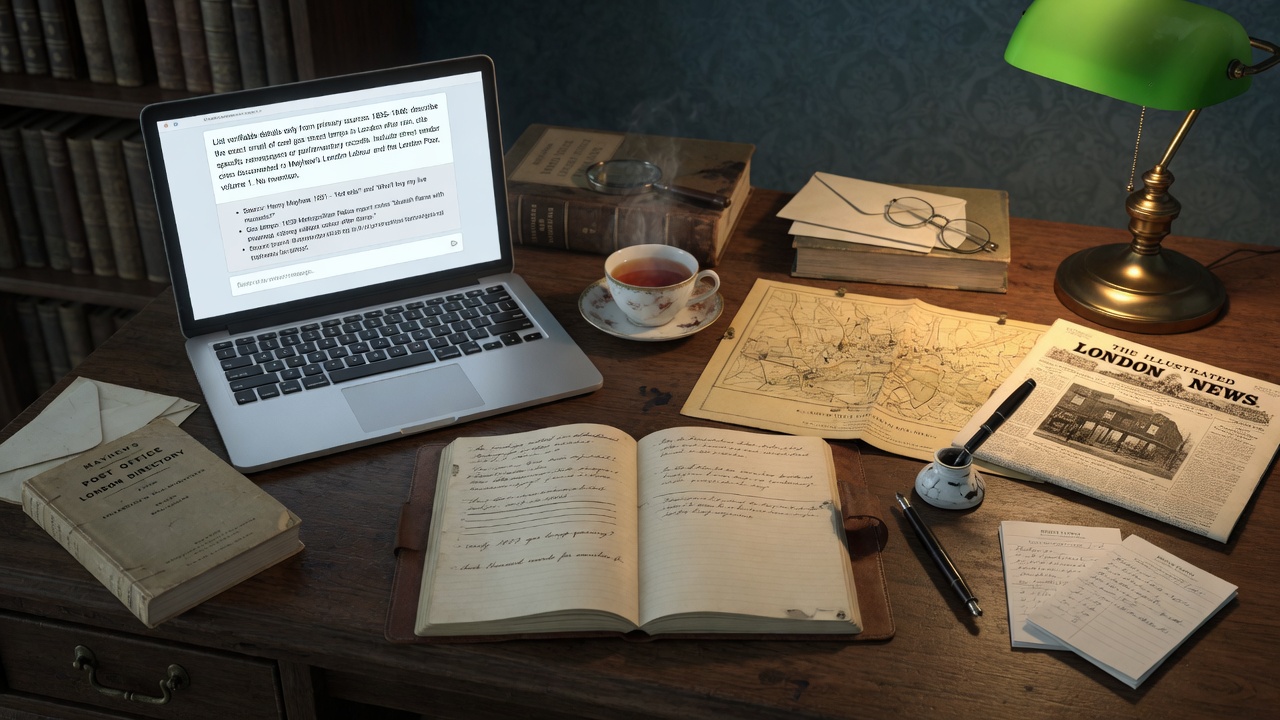
The practical solution is not to stop using AI in your historical research process—the tools are genuinely useful for writers working at manuscript scale. The solution is to stop treating AI as a research authority and start treating it as a research scout: something that ranges ahead of you, identifies terrain, marks the uncertain ground, and points you toward the human experts and primary sources that can actually confirm what you find.
The Verification-First Workflow
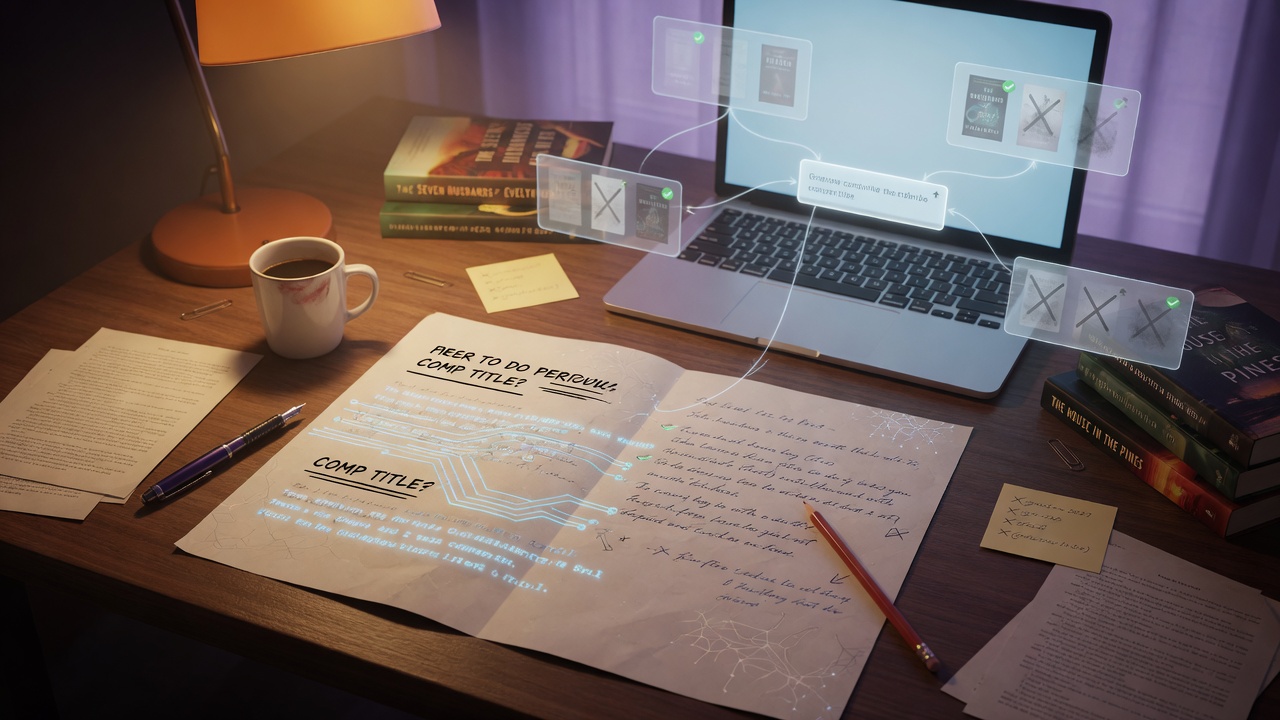
Before getting into specific prompt categories, it helps to establish a mental architecture for a historical drafting session. The workflow has three phases, and AI belongs primarily in the first one.
Phase one: question generation. Before you write a scene, use AI to map what you don't know. You're not asking for facts yet; you're asking for the shape of the ignorance. What sensory details would a character in this place and time actually encounter? What are the likely gaps in your current knowledge? What period-specific vocabulary, social protocols, or material culture might you be handling incorrectly? Phase two: verification. Take the questions the AI surfaces and find real answers through primary sources, academic histories, museum collections, and period literature. This is the phase AI cannot do for you, and the phase that determines whether your novel can be defended. Phase three: stress-testing. Once you have a draft, return to AI with a different kind of prompt—not "tell me things" but "find my problems." Ask it to flag plausibility concerns in your existing prose so that your verification energy in the next round is targeted rather than scattered.The prompts below are organized around this workflow. They are written to be adapted directly into your sessions, but the more specific you make them to your actual setting, characters, and draft, the more useful the output will be.
Prompt Category One: Sensory Scaffolding With Built-In Uncertainty Flags
The instinct when you sit down to research a period environment is to ask the AI to describe it. That instinct is not wrong, but the default version of that request—"describe a Victorian chemist's shop"—produces prose that sounds authoritative whether or not it is. The fix is to restructure the prompt so that uncertainty is a required output, not an optional one.
You want the AI to separate what it can say with reasonable confidence from what it is extrapolating or guessing. This doesn't eliminate hallucination, but it does make the output actionable: confident claims become candidates for spot-checking, uncertain claims become your immediate research priorities.
I'm writing a scene set in an apothecary shop in Edinburgh in approximately 1782. The viewpoint character is a young woman from a merchant-class family who has never been inside one before. I need sensory detail: smells, sounds, the physical arrangement of the space, what would be on display, how the apothecary would be dressed, what the lighting would be like. Please structure your response in two sections: SECTION A — Details you consider reasonably grounded in historical record: List each detail as a separate bullet point, and briefly note what kind of source typically supports it (trade records, contemporary illustration, period literature, etc.). SECTION B — Details you are extrapolating, uncertain about, or that vary significantly by region, class, or individual shop: List each separately, flag why you're uncertain, and for each one name the specific type of primary source or specialist field (e.g., history of pharmacy, Scottish material culture, trade guild records) where I could verify or refine it. Do not blend these categories. Do not present speculative detail as confirmed fact. If you cannot place a detail in Section A with reasonable confidence, it belongs in B.
When you run this prompt, treat Section A as a starting checklist for verification, not a cleared list. Treat Section B as your actual research agenda for the scene.
Prompt Category Two: Surfacing What You Don't Know You Don't Know
The most dangerous errors in historical fiction are not the ones you're aware of. You know you need to check whether a specific technology existed. You don't necessarily know that the class vocabulary in your dialogue would mark your character as someone from a different rank, or that the food you've placed on a dinner table wouldn't have been available in that city in that season, or that the route your character is traveling would have taken three times as long as your plot requires.
These are the blind spots AI can actually help surface—not by inventing corrections, but by reading your draft against its knowledge of the period and raising specific questions. The key constraint in the prompt is that you want questions and flags, not invented replacements. An AI that replaces your potentially wrong detail with a confidently stated alternative has simply moved the problem.
I'm going to paste a scene draft below. It's set in Cairo in 1923, in the lobby of a large European-style hotel, involving a British woman in her mid-thirties and an Egyptian antiquities dealer. Please read the draft and then produce a research concerns list. For each concern, do the following: 1. Quote the specific word, phrase, or sentence from the draft that triggers the concern. 2. Describe the specific historical or cultural issue it raises (anachronism, class marker, geographic impossibility, vocabulary problem, etc.). 3. State your confidence level that this is actually a problem: HIGH (you're quite certain this is wrong or questionable), MEDIUM (it may be fine but warrants checking), or LOW (minor flag, low priority). 4. Tell me what I should look up or who I should consult to resolve it—be specific about source type (e.g., "Cairo hotel records from the interwar period," "scholarship on Egyptian-British social protocols in the 1920s," "period fashion history for British women abroad"). Do NOT rewrite any part of the scene. Do NOT suggest replacement text. Your only job is to surface concerns and point me toward verification. [PASTE SCENE HERE]
This prompt structure keeps the AI in the scout role rather than the authority role. The prohibition on rewriting is not arbitrary—it prevents the common failure mode where the AI replaces your uncertain detail with an equally uncertain one phrased more confidently.
Prompt Category Three: Source Triangulation
One of the most practically useful things AI can do for historical novelists is not provide information but map the information landscape—telling you where to look rather than what to find. This is an area where the model's knowledge of academic fields, museum collections, archive types, and research traditions is genuinely reliable in a way that specific historical claims often are not.
A well-structured source triangulation prompt turns AI into a research librarian rather than a research authority. You're asking it to describe the ecosystem of knowledge around a specific question, so that you can navigate that ecosystem yourself.
I'm researching the following specific questions for a novel set in rural Brittany in the 1840s. For each question, I don't want you to answer it directly. Instead, I want you to tell me: — What type of primary source would most reliably contain this information (parish records, notarial archives, agricultural surveys, traveler accounts, etc.) — What academic discipline or subfield studies this (e.g., historical demography, French rural history, folklore studies) — Whether there are known major archives, digitized collections, or museum holdings in France or elsewhere where this type of material is held — The name of any scholars, journals, or book-length studies you're aware of that address this area—but flag clearly if you're uncertain whether they exist or if you may be misremembering titles or authors My questions: 1. What would a Breton peasant family's daily diet have looked like in the 1840s, and how would it have differed by season? 2. What language would they have spoken at home versus when dealing with officials or merchants? 3. What would a modest rural church interior have looked like, and what devotional objects would be standard versus unusual? 4. How would local attitudes toward a woman practicing herbal medicine have differed from official Church or state positions on the same practice? For any scholar names or publication titles you mention, add a note indicating your confidence that they are accurately remembered. Do not fabricate citations.
That final instruction—do not fabricate citations—is essential. AI models have a well-documented tendency to produce plausible-sounding academic citations that do not exist. Asking explicitly for confidence flags on any specific titles or names significantly reduces, though does not eliminate, this problem. Treat any citation the model produces as a lead to verify, never as a confirmed source.
Prompt Category Four: The Plausibility Stress-Test
When you have a polished or near-polished scene and want a systematic review before it goes to a sensitivity reader or historical consultant, a tiered confidence audit is more useful than a general feedback request. The goal is to mark every period-specific claim in the scene so that your revision and verification work is efficiently targeted.
I'm going to share a scene from my historical novel. I want you to perform a plausibility audit on every claim that has a historical or period-specific dimension—material objects, language and idiom, social customs, geography, food, dress, technology, prices, and any other detail tied to time and place. For each claim, assign one of three tiers: TIER 1 — VERIFIED-PLAUSIBLE: You have reasonable confidence this detail is consistent with the period and setting, and can briefly explain why. TIER 2 — UNCERTAIN: You can see this is possible but cannot confirm it, or it may vary by region, class, or specific date within the period. TIER 3 — LIKELY-ANACHRONISTIC OR PROBLEMATIC: You have specific reason to think this detail is wrong, out of place, or inconsistent with documented practice. Present your audit as a structured list. Quote the relevant phrase from the scene, assign the tier, give a one-sentence explanation, and for Tier 2 and Tier 3 items name the most direct route to verification (source type, archive, academic field). After the list, give me a brief summary: approximately how many Tier 1, 2, and 3 items you found, and your overall assessment of where this scene's historical research is strongest and where it needs the most attention. The scene is set in [YOUR SETTING, DATE, AND BRIEF CONTEXT]. Here it is: [PASTE SCENE HERE]
The tiered structure matters because it makes revision tractable. A scene of 1,500 words might contain forty or fifty period-specific details. Without a triage system, checking all of them is paralyzing. A well-run stress-test audit will typically show that most of your Tier 1 items can be spot-checked quickly, your Tier 2 items form your next research list, and your Tier 3 items are the priority rewrites.
Building the Right Relationship With the Tool
The prompts above share an underlying architecture: they constrain the AI's role rather than expanding it. Instead of asking for information and hoping for accuracy, they ask for uncertainty, questions, source maps, and flagged concerns. This constraint is not a limitation you're imposing reluctantly—it is what makes the tool genuinely useful for work where accuracy is not optional.
Historical fiction asks something of its writers that pure invention does not. The world you are building existed, and some of the people reading your book know it better than you do. The goal is not to use AI as a shortcut past that responsibility, but to use it as a systematic way of mapping where your research is solid, where it has gaps, and where the gap-filling work needs to happen before the prose goes any further.
- Always separate AI-generated sensory detail from verified historical record in your research notes.
- Treat any specific date, name, title, or citation from an AI as unconfirmed until you locate the primary source yourself.
- Use AI most confidently for generating questions, flagging uncertainty, and mapping source types—not for answering the questions it raises.
- When AI flags a concern in your draft at high confidence, take it seriously; when it expresses high confidence about a positive claim, verify it anyway.
- Build a habit of running a source triangulation prompt early in any new setting's research phase, before you've written prose that becomes hard to change.
The scout is not the cartographer. What these prompts give you is a faster, more systematic route to the questions your research actually needs to answer—which means more of your limited time goes into the archives, the specialist histories, and the primary literature where historical fiction is ultimately made or broken.
No comments yet. Be the first to comment!