




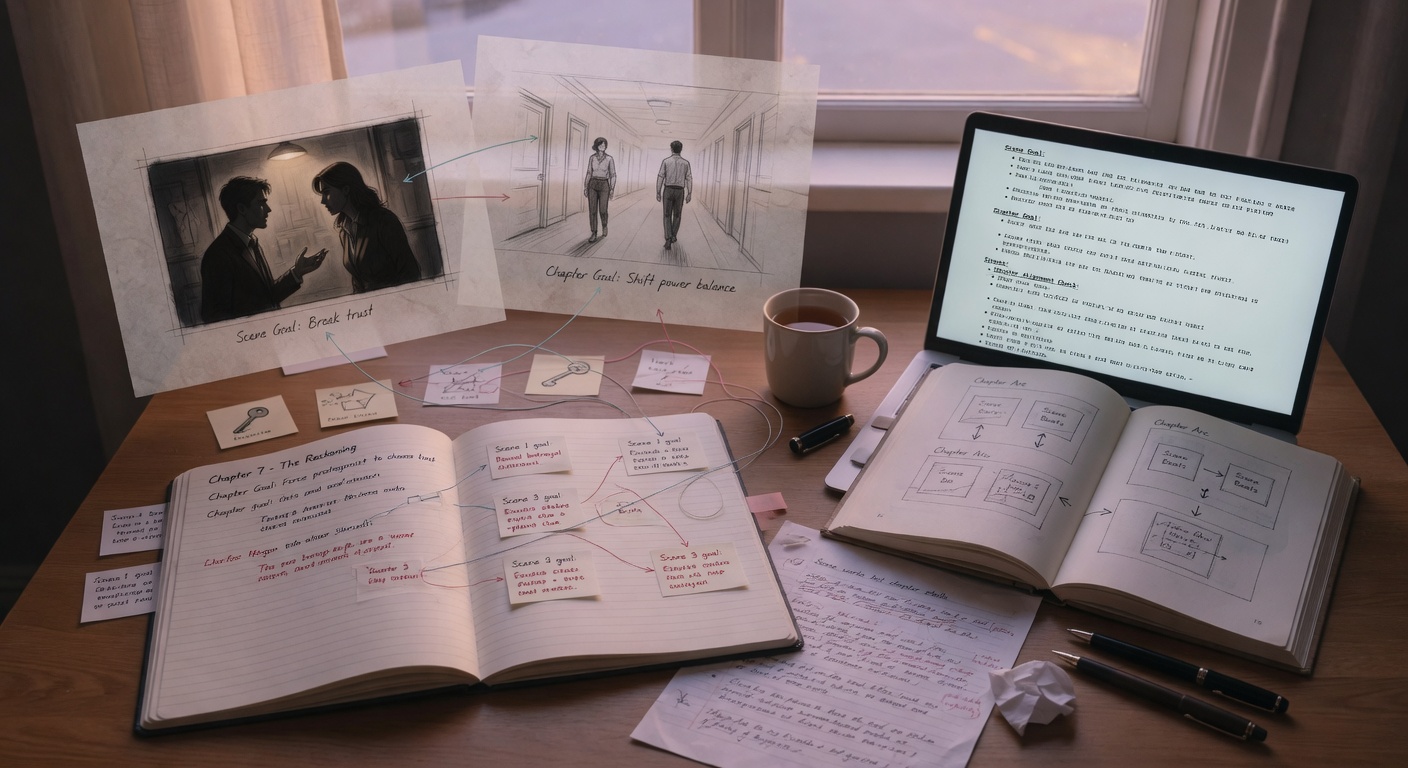
Scene Goals vs. Chapter Goals: AI Prompts That Keep Both in Focus While You Draft
The Two-Level Problem Most Novelists Don't Notice Until It's Too Late
You finish a chapter and something feels wrong. Each individual scene is competent—the dialogue crackles, the emotional beats land, the prose does what you asked it to do. But when you set the chapter down and step back, you realize almost nothing happened. The protagonist is essentially where she started. The subplot you needed to advance is still sitting in neutral. The reader has been entertained, but not moved forward.
This is the two-level problem, and it plagues more first drafts than any other structural issue. It lives in the gap between scene goals and chapter goals—two distinct layers of intent that have to work together if a chapter is going to earn its place in your manuscript.
A scene goal is a micro-level objective: reveal that Marcus has been lying about his alibi, raise tension between the sisters before the confrontation, shift the mentor relationship from warm to suspicious. It operates at the level of the immediate dramatic unit. A chapter goal is a macro-level objective: move the protagonist meaningfully closer to or further from what she wants, advance a specific subplot by one concrete step, deliver the story's midpoint complication. It operates at the level of the chapter as a structural building block in your larger novel.
Here's the insidious part: these two levels can each succeed while actively undermining the other.
Consider a breakup scene. You write it well. The dialogue is raw and specific, the emotional undercurrent is palpable, the reader feels the loss. That scene absolutely accomplished its micro-goal—it revealed the fracture in the relationship with precision and weight. But your chapter's macro-goal was to show your protagonist taking a decisive step toward the antagonist's inner circle. The breakup scene, beautifully written as it is, consumed all the chapter's emotional oxygen and left no room for that decisive step. The chapter is moving but inert. Scenes that work scene-by-scene without serving the chapter-level architecture are one of fiction's quietest structural sins.
The reverse is equally damaging. You draft a chapter that dutifully checks every plot box—the protagonist gets the information, the alliance shifts, the subplot advances—but it all happens in three scenes that feel perfunctory and rushed. Readers notice they've been fed story mechanics without emotional sustenance. They keep turning pages, but with less investment. Both failure modes are real. Both are preventable when you prompt your AI collaborator with clarity at both levels.
Defining Your Chapter's Macro-Goal Before You Prompt Anything
Before you open a chat window and ask an AI to help you draft a scene, you need a clear statement of what the chapter as a whole must accomplish. Without that anchor, you're asking for scene-level help in a structural vacuum—and you'll get exactly that.
A useful macro-goal statement has three parts:
- Protagonist desire: What does your protagonist specifically want by the end of this chapter? Not what they want from the whole novel—what they're reaching for in these particular pages.
- Obstacle: What specific force, person, or internal condition stands between the protagonist and that want in this chapter?
- Net change: By the chapter's final line, what has shifted—in situation, in knowledge, in relationship, in the protagonist's internal landscape? The shift doesn't have to be large, but it must be real and directional.
A completed macro-goal statement might look like this: Nadia wants to confirm whether Detective Harlow is working against her (desire). Her only access to that information is through his partner, who is deeply loyal and cautious (obstacle). By the chapter's end, Nadia has gained one piece of ambiguous evidence—not proof, but enough to make her distrust actionable (net change).
That's your chapter's structural spine. Every scene you draft within this chapter—every micro-goal you hand to an AI—needs to be bookended against this spine. When you give an AI model this macro-goal upfront, before asking for scene-level help, the output shifts noticeably. Instead of generating a scene that works in isolation, the AI can draft content that earns the chapter's larger payoff, plants the right details, and calibrates emotional weight proportionally rather than spending it all in one place.
Prompt Strategy 1: The Dual Brief
The dual brief is how you front-load both levels of intention into a single prompt. You give the AI the chapter's macro-goal and the scene's micro-goal simultaneously, make clear which is the container and which is the content, and then ask it to draft with both in view.
The structure looks like this: establish the chapter goal, establish the scene's specific job within that chapter, name any character or tonal constraints, and then make an explicit request that the scene serve the larger architecture without losing its own immediate purpose.
CHAPTER MACRO-GOAL: Chapter 14 must advance the subplot of Nadia's distrust of Detective Harlow. By the chapter's final line, she should have one piece of ambiguous evidence that makes her suspicion actionable—not proof, but a directional shift in her knowledge and her willingness to act on it. SCENE MICRO-GOAL: This specific scene (Scene 2 of Chapter 14) must plant that ambiguous evidence through a conversation between Nadia and Harlow's partner, Renata. Renata is guarded and genuinely loyal to Harlow—she won't volunteer anything. The evidence should emerge through what Renata does NOT say, or through a small behavioral inconsistency Nadia notices, not through an obvious slip. CHARACTER CONSTRAINTS: Nadia is observant but not yet confrontational in this chapter. She's still gathering, not acting. Renata is intelligent and cautious; she should not feel like a convenient information dispenser. DRAFT REQUEST: Write this scene (approximately 900–1,100 words) so that it accomplishes its immediate micro-goal—the conversation itself—in a way that is emotionally credible and texturally specific. At the same time, calibrate the emotional weight so it doesn't exhaust the chapter's momentum; readers should feel the scene land, but should still feel forward pull toward what happens next. The ambiguous evidence Nadia notices should feel earned from within the scene logic, not planted for convenience. Flag any moment where you had to choose between scene-level authenticity and chapter-level function—I want to see where those tensions live.Notice the final instruction: asking the AI to flag moments where it had to trade scene-level authenticity for chapter-level function. That instruction is doing significant work. It transforms the AI from a drafter into a collaborator who surfaces the structural choices you'll need to review, rather than hiding them inside polished prose.
Here's a second dual brief variation, useful when you're working with a scene that carries heavy emotional load and risks consuming the chapter's oxygen:
CHAPTER MACRO-GOAL: Chapter 9 must move protagonist Daniel from passive grief into the first concrete action of his external plot—specifically, he must decide (not yet act, but decide) to confront his father about the inheritance. The chapter's net change is a shift from paralysis to intention. SCENE MICRO-GOAL: Scene 3 is the emotional climax of the chapter: Daniel finds a box of his late mother's letters that suggest his father concealed information from her before she died. This scene must land emotionally—Daniel's grief should be present and specific, not decorative. But it must also function as the catalytic moment that makes his decision (the chapter's macro-goal) psychologically credible. TONAL CONSTRAINT: The grief in this scene should feel real but not consuming. The scene cannot become a grief set piece that closes in on itself emotionally. The letters are the catalyst; Daniel's response is the engine. DRAFT REQUEST: Write Scene 3 (approximately 700–900 words). Draft the emotional content fully—don't soften or compress the grief to serve plot mechanics. Instead, find the internal logic that makes grief and dawning resolve coexist in the same moment. If you find the scene's emotional weight pulling against the chapter-level momentum, draft a brief note at the end describing the tension and offering one alternative approach that preserves both levels.Prompt Strategy 2: The Chapter Audit
Once you have a full chapter draft—whether you wrote it yourself, generated it with AI assistance, or some combination—the chapter audit prompt asks an AI to read the entire draft and evaluate which scenes are actively pulling weight toward the macro-goal and which have gone quiet.
This is different from asking for general feedback. You're asking for a structural accountability report, and you need to give the AI the same macro-goal framework you used when drafting.
I'm going to paste a full chapter draft below. Before you respond, read the entire draft without commenting. Then, using the framework I provide, give me a scene-by-scene audit. CHAPTER MACRO-GOAL (the standard I'm holding this chapter to): By the end of Chapter 14, Nadia should have one piece of ambiguous evidence that makes her distrust of Harlow actionable. The chapter's net change is a shift in her knowledge and her willingness to act—not proof, not confrontation, but a directional move toward both. FOR EACH SCENE IN THE DRAFT, TELL ME: 1. What is this scene's apparent micro-goal? (State what it seems to be trying to accomplish on its own terms.) 2. Is this scene pulling toward, pulling against, or running parallel to the chapter's macro-goal? Be specific about how. 3. Is there any scene that is technically competent—well-written, emotionally credible—but structurally inert relative to the macro-goal? If so, name it and explain the disconnect. 4. Is the chapter's macro-goal actually delivered by the final line, or does the chapter end having approached but not completed its net change? Do not suggest line edits. Do not rewrite anything. I want structural diagnosis only—tell me what the chapter is doing architecturally, not how the prose reads. [PASTE CHAPTER DRAFT HERE]The instruction to withhold line edits is important. If you don't include it, most AI models will default to a mix of structural observation and prose suggestions, which muddies the diagnosis. You want the chapter audit to operate at the level of architecture, full stop.
Avoiding the Trap of Over-Optimization
There's a version of this two-level discipline that becomes its own problem: the chapter that has been so carefully engineered to serve both micro-goals and macro-goals that it has no room left for surprise. Every scene lands exactly where you pointed it. Every character does precisely what the structure required. The chapter is airtight and somehow airless.
Good fiction makes room for discovered material—the character who says something you didn't plan, the image that surfaces from the prose itself and turns out to carry more meaning than anything you deliberately planted. When you're working with AI, that spontaneity has to be invited rather than assumed. The dual brief can become a creative cage if you deploy it without a release valve.
Build permission into your prompts. After you've established your macro and micro goals, include a sentence like: If you encounter a moment where a character wants to do something the brief doesn't account for—something that feels psychologically true even if it complicates the structure—draft it and flag it rather than suppressing it. That instruction keeps the scaffold from becoming a straitjacket.
You can also ask the AI to perform a brief spontaneity check on a finished draft:
- Does any scene feel over-controlled—like every beat was placed rather than discovered?
- Is there a moment where a character's behavior seems to serve the plot's needs rather than their own internal logic?
- Where, if anywhere, did the draft surprise you in the drafting?
The goal of all this dual-level prompting is not to produce a chapter that is structurally flawless. It's to prevent the specific failure modes that come from working at only one level at a time—the beautiful scene that goes nowhere, the plot beat that lands without weight. When you give both levels their due, and when you build your AI prompts to hold both simultaneously, you get drafts that move and feel—which is the only thing readers actually ask of a chapter.





No comments yet. Be the first to comment!