


Why Series Continuity Breaks Differently Than Single-Novel Continuity
A standalone novel is a closed system. You seed a detail on page 40 and pay it off on page 300, and the whole structure exists in one cognitive workspace—yours, your editor's, your beta readers'. You can hold the shape of it.
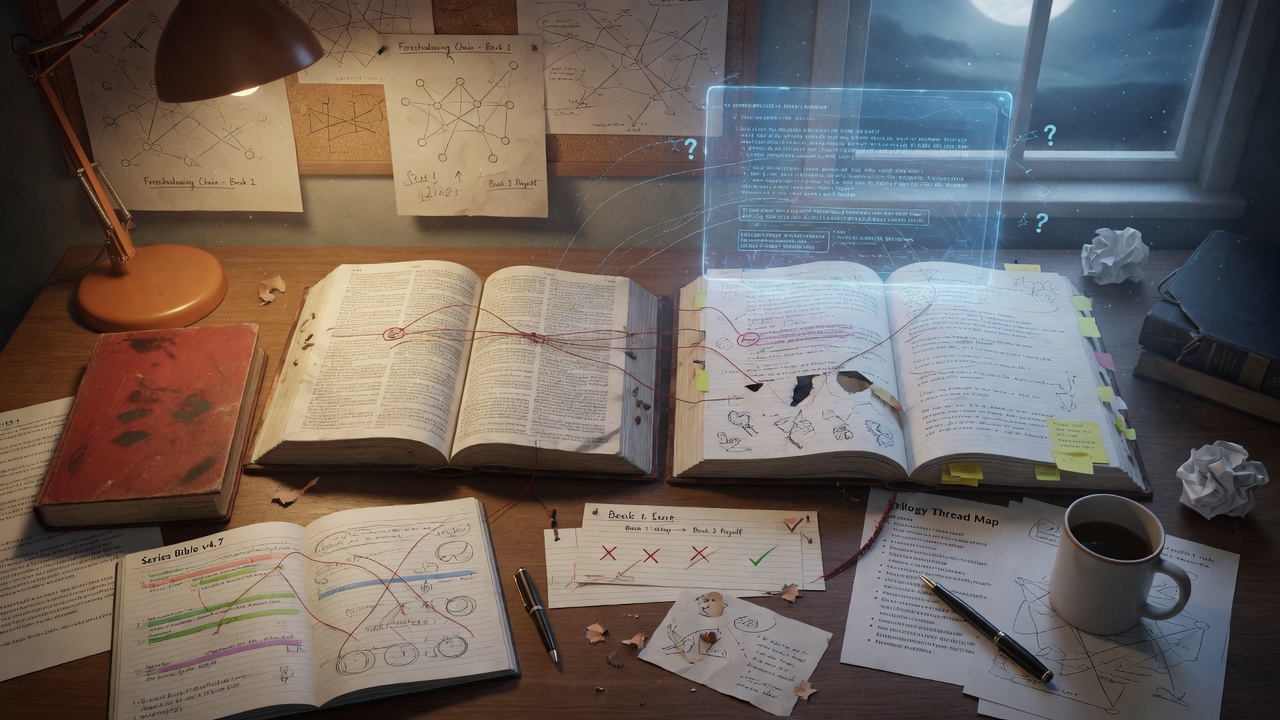
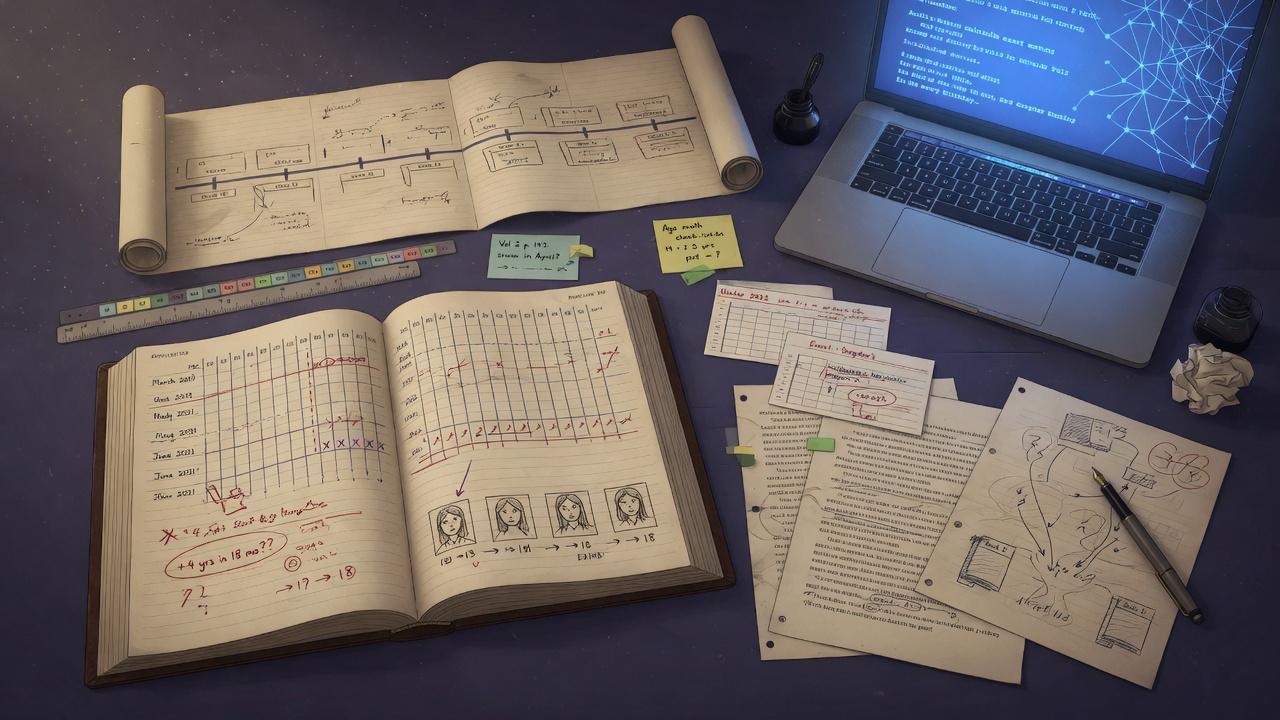
A trilogy is something else entirely. When you're drafting Book 3, the promises you made in Book 1 were written eighteen months ago, possibly by a slightly different version of yourself with a slightly different vision for where the series was going. The foreshadowing you planted in chapter seven of the first volume—the recurring image of a broken compass, the offhand mention of a dead character's unfinished letter, the prophecy that sounded decorative but wasn't—those details don't get easier to track as the word count climbs toward 300,000. They get buried.
Series continuity failures aren't usually the result of carelessness. They're a structural problem. The promises live in one manuscript, the payoffs in another, and the gap between them is measured in years of drafting, revision, editorial feedback, and the gradual drift of your own creative instincts. Readers, however, experience the series as a unified object. They remember the broken compass. They will notice when you forget it.
This is where AI becomes genuinely useful—not as a co-author, but as an extraordinarily patient reference system that can hold your entire series in working memory simultaneously and answer specific, structured questions about what you've committed to and whether you've honored those commitments.
Building a Thread Inventory: Extracting What You've Already Promised
Before you can audit continuity, you need a complete picture of every unresolved thread, seeded detail, and recurring motif across your existing manuscripts. This is the thread inventory, and it's the foundation of everything else.
The challenge is that foreshadowing doesn't announce itself. Chekhov's gun doesn't come with a label. A symbolic motif might appear as an incidental description three times before it crystallizes into something load-bearing. An AI working through your manuscript needs explicit instruction about what categories of detail to flag, or it will return a generic summary rather than the granular inventory you need.
Paste in a chapter or a full manuscript (depending on your tool's context window) and work with a prompt like this:
You are a developmental editor specializing in multi-book series continuity. I am going to provide you with the full text of [Book 1 / specific chapters]. Your task is to build a comprehensive thread inventory—a structured catalog of every narrative element that could require payoff or continuation in a later volume. Organize your inventory into these specific categories: 1. HARD FORESHADOWING: Explicit promises to the reader—prophecies, stated character goals, promises made between characters, objects described as significant, mysteries introduced but not resolved. 2. SOFT FORESHADOWING: Implied or atmospheric promises—recurring images (objects, colors, weather, phrases), patterns of behavior that suggest future consequence, symbolic details that appear more than once. 3. OPEN CHARACTER ARCS: Any character transformation, wound, or desire that is introduced but not resolved within this manuscript. 4. WORLD-BUILDING COMMITMENTS: Rules of magic, technology, or society that are established and will constrain what can happen in later volumes. 5. PLANTED CONTRADICTIONS: Details that seem inconsistent or deliberately mysterious—things that suggest the author knows something the reader doesn't yet. For each item, note: the approximate location (chapter/scene), the exact language used, and a one-sentence assessment of whether it reads as intentional setup or possible continuity risk. Do not summarize the plot. Do not assess quality. Catalog only.
Run this across each existing manuscript and compile the outputs. What you'll have is a working series bible appendix—not the narrative shape of your books, but the specific obligations those books have created.
Payoff Mapping: Comparing Seed Against Delivery
Once you have thread inventories for Books 1 and 2, the next step is systematic payoff mapping. This is where you ask the AI to function as a gap analyst: given everything Book 1 planted, what did Books 2 and 3 actually address, and what remains orphaned?
The key distinction here is between threads that are intentionally unresolved (building toward a later payoff) and threads that have been quietly forgotten. The AI can't make that determination—you can. But it can surface everything that hasn't been addressed so you can make a conscious choice about each item, rather than discovering the oversight when a reader emails you.
I am going to provide you with two documents: a thread inventory extracted from Book 1 of my series, and the full manuscript of Book 2 (or Book 3). Your task is to perform a payoff gap analysis. For every item in the thread inventory, search the provided manuscript and determine one of the following: RESOLVED: The thread received a clear payoff or continuation in this manuscript. Quote the relevant passage. PARTIALLY ADDRESSED: The thread is acknowledged or developed but not resolved. Note what progress was made and what remains open. ORPHANED: The thread does not appear in this manuscript at all—no reference, no payoff, no deliberate deferral. Flag these as high priority. CONTRADICTED: The manuscript contains information that conflicts with how the thread was established in Book 1. Quote both the original establishment and the contradicting passage. After completing the line-by-line analysis, provide: - A summary count in each category - Your top five highest-risk orphaned threads (those that seemed most intentional or prominent in the original seeding) - Any patterns you notice—are entire categories of thread being systematically dropped? [Thread Inventory from Book 1] [Full text of Book 2 or Book 3]
This prompt treats the AI as a cross-reference engine, not a creative consultant. The output won't tell you what your series means or how to fix problems—it tells you where the gaps are. That's the work.
Motif Drift Detection: When a Symbol Quietly Changes Its Mind
Motif drift is subtler than a forgotten thread, and it's arguably more damaging to a reader's experience. A forgotten thread creates a hole; a drifting motif creates confusion at a level the reader may not be able to articulate. They just feel that something is off, that the series lost coherence between volumes, that the world became less itself.
Motif drift happens when a recurring symbol—a color, an object, a phrase, a ritual, a physical gesture—gradually accumulates associations that conflict with its original meaning. In Book 1, the color red means violence and warning. By Book 3, red has become associated with passion and transformation, but nobody made a deliberate choice to shift its meaning. It drifted through accumulated usage.
Sometimes drift is intentional. A symbol that changes meaning can be a profound structural choice—if the shift is earned, if the reader can trace the evolution. But unintentional drift reads as sloppiness, and it undermines the work the motif was doing.
I am going to provide you with three manuscript texts [or however many volumes you have]. I want you to track the following specific motif(s) across all three volumes: [list your motifs—e.g., "the recurring image of broken glass," "the phrase 'the cold that comes before,'" "the ritual of burning letters," "the color blue as used in descriptions of the antagonist"]. For each motif, create a chronological catalog of every appearance across all three manuscripts. For each appearance, note: - The exact passage - The volume and approximate location - The emotional or thematic context of the scene - What the motif seems to signify in this specific instance After cataloging all appearances, analyze the following: 1. Is the motif's meaning consistent across all three volumes, or does it shift? 2. If it shifts, at what point does the shift occur, and does the text mark that shift deliberately or does it happen without acknowledgment? 3. Are there any appearances that seem to contradict the motif's established meaning without narrative justification? 4. What is the cumulative thematic statement the motif makes when all appearances are read together? Flag any appearances that seem inconsistent with the motif's dominant usage as continuity risks.
Run this prompt for each significant recurring element in your series. The output gives you a motif biography—the full life of that symbol across your books—which makes it possible to see drift that's invisible when you're reading one volume at a time.
Reader Amnesia Simulation: What a Series Reader Actually Remembers
There's one more continuity problem that thread inventories and payoff maps don't fully address: the gap between what you know about your own series and what a reader who finished Book 1 eighteen months ago will actually remember when they open Book 3.
Series continuity isn't just about whether you've technically paid off a thread. It's about whether you've paid it off in a way that will register for someone who has forgotten the setup. If Book 1's chapter seven contains a single, low-key mention of a character's dead sister, and Book 3 treats that dead sister as the emotional centerpiece of the climax, you have a continuity problem even if you technically planted the detail. The payoff will land as arbitrary rather than earned, because the setup didn't leave a strong enough impression.
This is the reader amnesia problem, and it requires a different kind of audit.
I want you to perform a reader amnesia simulation for my series. I am going to provide you with [the thread inventory / full text] of Book 1 and the manuscript of Book 3. Your task is to evaluate each significant plot element, character revelation, and emotional payoff in Book 3 and assess whether a reader who read Book 1 eighteen months ago—without rereading it—would have sufficient recall of the setup to experience the payoff as earned rather than arbitrary. For each payoff moment in Book 3, identify: 1. What setup in Book 1 (or Book 2) this payoff depends on for its impact 2. How prominently that setup was staged—was it a major scene, a brief mention, an atmospheric detail? 3. Whether Book 3 provides adequate in-text orientation for a reader with imperfect recall—does it briefly re-anchor the setup before delivering the payoff, or does it assume memory the reader may not have? 4. A risk rating: LOW (setup was prominent enough to be memorable), MEDIUM (setup may need a light callback or re-anchoring in Book 3), HIGH (setup was too subtle to survive eighteen months—the payoff will likely read as unearned without revision). Do not suggest specific revisions. Identify risks only. I will determine the appropriate response to each.
Working With the Output: What to Do With What You Find
Triage Before You Revise
A thorough continuity audit will return more issues than you can address in a single revision pass—and not all of them matter equally. Before touching a word of your manuscript, sort the AI's output into three buckets:
- Structural problems: Orphaned threads that were prominently seeded and will register as broken promises if unresolved. These require revision.
- Coherence risks: Motif drift or reader amnesia issues that will create confusion without necessarily reading as plot holes. These require attention, sometimes just a single orienting sentence.
- Intentional choices: Threads you seeded but decided not to pay off, or motif shifts that were deliberate. Document these decisions so they don't keep surfacing as false positives in future audits.
Build the Living Bible
The thread inventory you extract before Book 3 shouldn't disappear after you ship the book. A series bible built from systematic AI audits—cataloging what was planted, what was resolved, what was deliberately left open—is an asset that compounds in value if you return to the world, write companion novellas, or simply want to answer reader questions with confidence.
Update the inventory after each significant revision pass. Note when threads are resolved. Flag what remains open. The document becomes a record of promises kept and a map of what you've built—which is something no amount of memory or notes-app chaos can replicate across the span of years that a multi-book series actually takes to write.
The Limits of the Tool
AI continuity audits catch structural and symbolic problems with real reliability. They don't assess whether your payoffs are emotionally satisfying, whether your motifs are doing interesting thematic work, or whether a forgotten thread is actually worth picking back up. Those remain craft judgments that belong to you and your readers.
What the prompts above do is eliminate a specific category of preventable failure—the kind where you simply didn't know what you'd forgotten. That's a narrow job, but it's a consequential one. The broken compass matters. The reader who noticed it on page 47 of Book 1 is waiting.

No comments yet. Be the first to comment!